November 7-9, 2023
Beyond Lakes: Linking Science, Culture and Governance for their Sustainable Use
World Lake Conference:
The history of the World Lake Conference (WLC) dates back to the Shiga Conference on Conservation and Management of World Lake Environment of 1984, known as LECS’84, which was held on the shore of Lake Biwa, Japan. The aim of the LECS’ 84, which was to contribute to promoting scientific approaches in the world lake basin management, has been inherited to the World Lake Conferences held in various parts of the world including USA, Hungary, China, Italy, Argentina, Denmark, Kenya, India, Indonesia and Japan.
Today, the Conference is globally recognized as a place for multi-sectoral participants (i.e., academia, government, citizens, NGOs and enterprises) to exchange their views and experiences on the sustainable management of lakes and their basins. The conference is organised every 2 years in cooperation with the International Lake Environment Committee (ILEC).
The 19th World Lake Conference was organised in November 7-9, 2023 in Balatonfüred (Hungary) in the Congress Center. This was the second time that Lake Balaton hosted the conference. In 1988, the 3rd WLC was organized at Keszthely, which focused on lake degradation issues, such as eutrophication, acidification, toxic substances, modelling, rehabilitation options and the role of stakeholders in the protection and conservation of lakes. At this conference, we took these issues to the next level and complemented these themes by presenting appropriate and effective tools to maintain the ecosystem services provided by lakes.
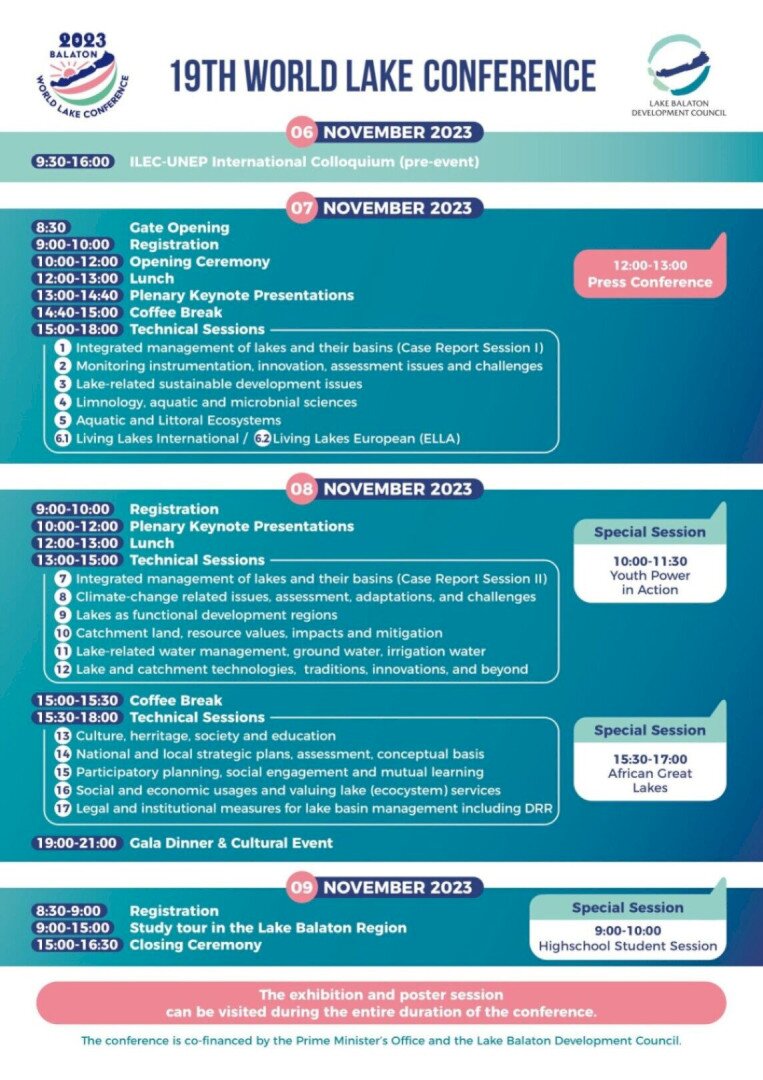
Programme: The final programme of the Conference is available among the downloadable materials.
Publications:
On the first two days of the Conference, participants attended plenary presentations and thematic sessions to learn more about the researches and project results implemented to foster the sustainable management of Lake Balaton and other large lakes in the world. On the closing day of the Conference, the participants went to a boat trip (as a study tour), where the regional partner organisations of the Lake Balaton Development Council presented their activities and projects.
Facts and figures:
All together there were 13 plenary and 96 thematic presentations at the Conference. In addition, 3 special sessions were organised (as side events). The Conference was organised as an in-person event. However, some special sessions were organised in hybrid-format. In total, more than 120 foreign and more than 140 national participants attended the Conference. The majority of participants attended more than one day at the Conference. As an average, about 200 people attended the Conference each day and more than 120 participants attended the study tour.
Besides the Hungarian participants, many foreigners attended also the event too, who came from all over the world: mostly from Asia (mainly Japan, Indonesia, India, China) and Africa (mainly Kenya, Rwanda, South Africa). But many participants came also from Europe (mainly Brussels, Germany, Poland, Italy, UK), and from the United States, Canada, Mexico, Bolivia and Brazil.
WLC19 Documents and Publications:
- Book of Abstracts (ISBN 978-615-01-9589-6)
- Conference Proceedings (ISBN 978-615-02-1900-4)
Balaton Declaration:
The 19th World Lake Conference was the first major international lake-related event since the unanimous adoption of the resolution on the sustainable management of lakes. As such, the conference represented a significant opportunity to draw attention to the challenges and objectives related to the sustainable management of lakes and their catchment areas, including the impacts of climate change and related extreme climate events (such as droughts and floods) on lakes, which worldwide significantly affect both aquatic and terrestrial ecosystems. Consequently, there is a heightened need for integrated climate planning in lake regions.
As a result, the participants of the conference, within the framework of the “Balaton Declaration,” formulated recommendations for the present generation and future generations to promote the sustainable management of lakes, catchment areas, and ecosystem services, in line with the objectives set out in the UN resolution on the sustainable management of lakes.